
Traffic without conversions is just noise. You can have thousands of visitors landing on your pages every month — but if those pages are not built to convert, the majority of that traffic leaves without taking any action.
The difference between a landing page that consistently converts visitors into customers and one that does not almost always comes down to the same set of landing page best practices — proven principles of design, copy, speed, and user experience that guide visitors toward taking the action you want them to take.
In this guide we will walk you through every category of landing page best practices — from design and copywriting to speed optimization, mobile performance, SEO, and ongoing testing — so you can build landing pages that work as hard as the traffic you are sending to them.
Whether you are building service pages, lead capture pages, or eCommerce product pages on WordPress, these landing page best practices will help you convert more of your existing traffic into real business results.
What Are Landing Page Best Practices and Why Do They Matter
Landing page best practices are the proven principles and techniques that consistently produce higher conversion rates across different industries, traffic sources, and website types. They are derived from years of conversion rate optimization research, A/B testing data, and real-world performance analysis.
A landing page that follows landing page best practices is one that:
- Communicates its value proposition immediately and clearly to every visitor
- Removes every unnecessary element that does not directly support the conversion goal
- Builds trust and credibility through social proof, guarantees, and security signals
- Loads fast on every device — particularly mobile
- Guides visitors toward a single clear action through intentional design and copywriting
- Is continuously tested and improved based on real visitor behavior data
For WordPress website owners, applying landing page best practices is one of the most direct and highest-return investments available — because it improves the conversion rate of traffic you are already receiving without requiring any increase in advertising spend or SEO effort.
Every percentage point improvement in conversion rate multiplies the revenue value of every visitor who lands on your page — making landing page best practices one of the most powerful levers available for business growth online.
Landing Page Best Practices — Design and Layout
The design and layout of your landing page creates the first impression that determines whether visitors trust your page enough to keep reading. These landing page best practices for design ensure every visual decision supports your conversion goal.
Keep the Design Clean and Focused
The most fundamental of all landing page best practices is simplicity. A clean focused design keeps visitor attention on the single action you want them to take — rather than pulling it in multiple directions simultaneously.
- Remove navigation menus from dedicated campaign landing pages — every navigation link is an exit opportunity that takes visitors away from your conversion goal
- Eliminate sidebars, secondary offers, and unrelated content that competes with the primary conversion goal
- Use generous white space to make content easy to read and the page easy to scan
- Limit the color palette to two or three brand colors — visual complexity reduces cognitive focus and increases decision fatigue
- Every element on the page should earn its place by directly supporting the conversion goal — if it does not contribute to conversion, remove it
- Avoid autoplay videos and moving elements that distract from the headline and call to action
A clean focused design is the visual foundation of every high-converting landing page — and one of the most consistently impactful landing page best practices across every industry and traffic source.
Use a Strong Hero Section Above the Fold
The hero section — the content visible before a visitor scrolls — is the most valuable real estate on any landing page. It must immediately communicate value and give visitors a compelling reason to keep reading.
- Your headline must be the first and most visually prominent element — visitors should be able to understand your offer within three seconds of landing on the page
- Include a supporting subheadline that expands on the headline promise and provides additional context or reassurance
- Feature a strong hero image or video that visually reinforces the offer — authentic images of real products, people, or results consistently outperform generic stock photography
- Place your primary call to action button within the hero section so it is visible without scrolling on both desktop and mobile
- Include one key trust signal in the hero section — a client count, a guarantee, a review rating, or a recognizable client logo — to immediately address the trust question every first-time visitor is silently asking
A compelling hero section is one of the most critical landing page best practices because it determines whether visitors engage further or leave immediately.
Make Your Call to Action Impossible to Miss
Your call to action is the most important element on any landing page. Every design decision should make it easier to find, understand, and click. Weak or buried CTAs are one of the most common violations of landing page best practices.
- Use a button color that contrasts strongly with the page background — your CTA button should stand out immediately from every other element on the page
- Make the button large enough to be immediately visible without requiring effort to locate
- Use action-oriented button text that clearly states what happens next — “Get My Free Quote”, “Start My Free Trial”, “Book a Consultation” outperform generic “Submit” or “Click Here” consistently
- Place the CTA above the fold and repeat it at logical intervals throughout the page — typically after each major benefit section
- Add a brief reassurance line below the CTA button — “No commitment required”, “Free consultation”, “Cancel anytime” — to reduce the perceived risk of clicking
- Ensure the CTA is just as prominent and accessible on mobile as it is on desktop
Use Visual Hierarchy to Guide Visitors
Visual hierarchy is the arrangement of design elements so that visitors naturally move through the page in the order that maximizes the likelihood of conversion. Intentional visual hierarchy is one of the most sophisticated but impactful landing page best practices.
- Use font size, weight, and color to create a clear visual priority — headlines largest, subheadlines medium, body text smallest
- Use directional cues — arrows, pointing figures, or eye gaze direction in images — to guide visitor attention toward your CTA
- Group related information together and separate it from other sections with clear visual breaks
- Use numbered lists and bullet points for benefit sections to make scanning easy — most visitors scan before they read
- Ensure the visual flow of the page moves naturally from problem to solution to evidence to action
- Test your visual hierarchy by squinting at the page — the most important elements should still be immediately identifiable even when the page is blurred
Landing Page Best Practices — Copywriting
Design gets attention — but copy closes conversions. These landing page best practices for copywriting ensure every word on your page is working to move visitors closer to taking action.
Write a Clear and Benefit Focused Headline
Your headline is the single most important piece of copy on your landing page. It is the first thing visitors read and the primary factor in whether they stay or leave. Writing a strong headline is the most impactful of all copywriting landing page best practices.
- Lead with the primary benefit your offer delivers — not the name of your product or service
- Be specific rather than vague — “Get a Professional WordPress Website Built in 14 Days” is more compelling than “We Build Websites”
- Use the visitor’s language — the words and phrases your target customers actually use when describing their problem or desired outcome
- Address the visitor’s primary pain point or desire directly — the headline should make every visitor feel immediately understood
- Keep headlines under 10 words where possible — clarity beats cleverness every time
- Test multiple headline variations through A/B testing — headlines typically produce the largest conversion differences of any page element tested
Focus on Benefits Not Features
One of the most consistently applied landing page best practices in professional copywriting is the shift from feature descriptions to benefit statements — because visitors buy outcomes not specifications.
- Translate every feature into the benefit it delivers for the visitor — “24/7 uptime monitoring” becomes “Your website stays online around the clock so you never lose a customer to downtime”
- Lead benefit statements with the visitor’s perspective — use “you” and “your” frequently to make copy feel personally relevant
- Use the “so what” test on every feature statement — ask “so what does this mean for the visitor?” until you reach the genuine benefit
- Order benefits by importance to the visitor rather than by what you consider most impressive
- Use specific concrete language for benefits — “Save 5 hours per week on website management” is more compelling than “Save time on your website”
- Address the visitor’s most significant objection directly within the benefits section — anticipating and resolving objections in copy is one of the highest-impact landing page best practices for converting hesitant visitors
Use Social Proof and Trust Signals
Visitors who do not know your brand need evidence from other customers and credible signals before they will trust you enough to take action. Social proof and trust signals are among the most powerful landing page best practices for overcoming purchase hesitation.
- Display genuine client testimonials with full names, photos, job titles, or company names — specific attributed testimonials are significantly more credible than anonymous quotes
- Show star ratings and review counts from Google or other reputable review platforms
- Include recognizable client logos if you have worked with known brands or organizations
- Display specific business metrics that demonstrate credibility — “100+ clients served”, “250+ projects completed”, “10+ years of experience”
- Add security badges, certifications, and guarantee messaging near your primary CTA to reduce the perceived risk of taking action
- For TecHippo landing pages, prominently featuring the genuine Google reviews from clients like Sir Zubair, Aqeel Azam, and Yasir Malik near the CTA section significantly strengthens conversion performance
H3: Create Urgency Without Being Pushy
Genuine urgency gives visitors a compelling reason to act now rather than postponing the decision indefinitely. Creating urgency is one of the landing page best practices most directly connected to immediate conversion rate improvement.
- Use genuine time-limited offers — first month free promotions, limited consultation availability, or seasonal pricing — where the deadline is real
- Show limited availability where it exists — “Only 3 onboarding slots available this month” is a powerful conversion trigger when it is true
- Highlight the cost of inaction — help visitors understand what they are losing every day they delay taking action
- Use deadline-based language in your CTA — “Claim Your Free Month Today” is more urgent than “Get Started”
- Avoid manufactured fake countdown timers that reset infinitely — visitors notice and it destroys trust permanently
- Frame urgency around the visitor’s goals rather than your sales targets — “The longer your website stays slow, the more customers you lose” is more compelling than “Sale ends Friday”
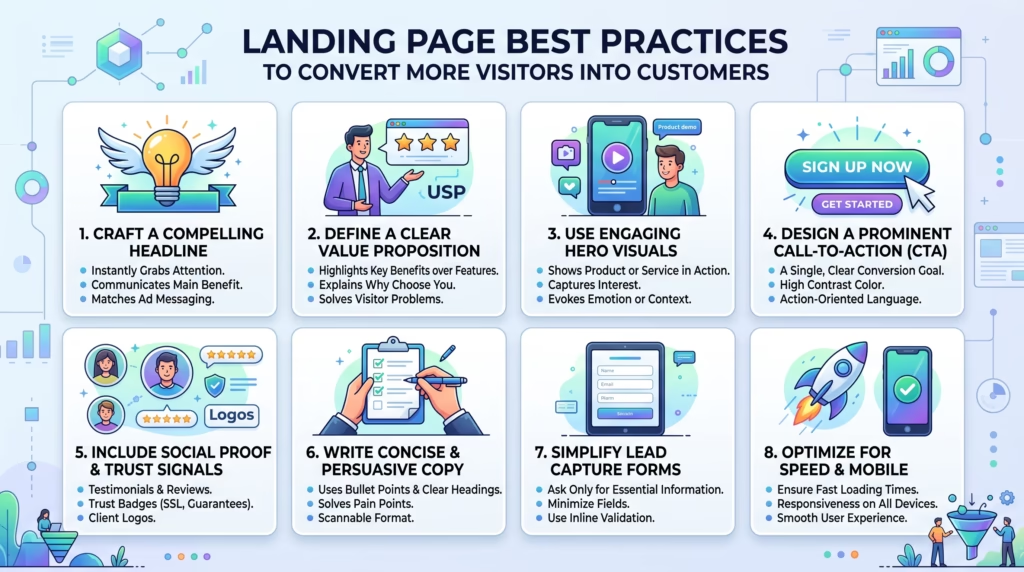
A landing page that looks professional but does not follow proven conversion principles is leaving significant revenue on the table every single day.
Our Custom WordPress Website Development and SEO & Growth Optimization services are built to design and build landing pages that apply every category of landing page best practices — strategically designed to convert more of your existing traffic into leads and customers.
Get in touch with TecHippo today for a free consultation and let’s build landing pages that actually convert.
Landing Page Best Practices — Speed and Performance
No design or copywriting best practice can overcome the conversion damage caused by a slow loading landing page. Speed is a non-negotiable foundation of every effective landing page best practices strategy.
Optimize Landing Page Loading Speed
Every additional second of loading time on a landing page reduces conversion rates measurably — making speed optimization one of the most directly revenue-impactful landing page best practices available.
- Choose a fast and reliable hosting provider as the performance foundation — poor server response time undermines all other speed optimizations
- Install and properly configure a WordPress caching plugin like WP Rocket or LiteSpeed Cache
- Use a CDN to serve landing page assets from servers geographically close to your visitors
- Minimize the number of third-party scripts loading on your landing page — every tracking pixel, chat widget, and analytics script adds loading time
- Run your landing page through Google PageSpeed Insights on the mobile tab before launching any campaign and address every issue flagged in the opportunities section
- Target a mobile PageSpeed score of 90 or above and an LCP score under 2.5 seconds before driving significant paid traffic to any landing page
Our Website Speed Optimization service delivers measurable landing page performance improvements that directly support stronger conversion rates and better Google Ads Quality Scores.
Compress and Optimize All Images
Images are typically the largest files on any landing page — making image optimization one of the most immediately impactful landing page best practices for loading speed improvement.
- Compress all landing page images before uploading using tools like ShortPixel or Imagify
- Convert images to WebP format for significantly smaller file sizes without visible quality loss
- Define explicit width and height dimensions on every image to prevent layout shifts during loading that hurt CLS scores
- Ensure your hero image — typically the largest above-the-fold file — is prioritized for fast loading using the fetchpriority attribute
- Serve appropriately sized images to mobile devices using WordPress’s built-in srcset functionality rather than loading desktop-sized images on mobile
- Use real photos of your team, work, or clients rather than large generic stock images — authentic images convert better and can usually be compressed more aggressively without quality loss
Minimize Scripts and Plugin Load
Every plugin and third-party script loaded on your landing page adds JavaScript that must be downloaded, parsed, and executed before the page is fully interactive — directly affecting INP scores and overall conversion performance.
- Audit every plugin active on your WordPress website and disable scripts from plugins that are not needed on your landing pages
- Use a performance plugin like Asset CleanUp or Perfmatters to prevent specific plugin scripts from loading on pages where they are not needed
- Load third-party scripts asynchronously where possible to prevent them from blocking the initial page render
- Remove or delay non-critical scripts — social media share buttons, secondary analytics tools, and decorative widgets — that add loading time without contributing to conversion
- Check your landing page’s JavaScript execution time in Google PageSpeed Insights and address any long tasks that delay interactivity
Landing Page Best Practices — Mobile Optimization
With the majority of web traffic now coming from mobile devices, landing page best practices for mobile are not optional — they are essential for any landing page targeting modern web audiences.
Design for Mobile First
The most important shift in modern landing page best practices is designing the mobile experience first — then adapting it for desktop — rather than the reverse.
- Design your landing page layout with a single-column mobile view as the starting point
- Ensure all content is readable and all interactive elements are usable without pinching, zooming, or horizontal scrolling on mobile screens
- Test your mobile layout at 375px width — the most common small smartphone screen size — as your minimum design target
- Ensure your hero section communicates the complete value proposition above the fold on mobile without requiring scrolling
- Use a page builder with native mobile view controls — Elementor, Beaver Builder, and the native WordPress block editor all allow independent mobile layout configuration
- Never hide important content on mobile using CSS display none — hidden content may not be fully counted by Google for ranking purposes
Mobile-first design is one of the landing page best practices with the most direct impact on both conversion rates and SEO performance given Google’s mobile-first indexing policy.
Use Large Tap Friendly Buttons
Touch interactions on mobile require larger and more generously spaced interactive elements than mouse interactions on desktop — making tap-friendly design one of the most important landing page best practices for mobile conversion optimization.
- Ensure all CTA buttons are at least 44px by 44px — Google’s recommended minimum tap target size for comfortable touch interaction
- Add sufficient padding around buttons so they are easy to tap accurately without hitting adjacent elements
- Make the primary CTA button full width on mobile screens for maximum visual prominence and tap accuracy
- Space multiple interactive elements — buttons, links, and form fields — far enough apart that accidental taps on adjacent elements are prevented
- Use high contrast button colors that are clearly visible on mobile screens in both indoor and outdoor lighting conditions
- Test all interactive elements on a real smartphone before launching — what looks adequately sized on a desktop design tool often feels cramped on an actual mobile device
Simplify Forms for Mobile Users
Forms are one of the highest-friction elements on any landing page — and that friction is significantly amplified on mobile devices where typing is slower and less accurate. Simplifying forms for mobile is one of the most directly conversion-impactful landing page best practices for mobile optimization.
- Reduce the number of required fields to the absolute minimum needed to follow up effectively — name and email is sufficient for most lead capture forms
- Use single-column form layouts on mobile — multi-column forms are difficult to complete accurately on small screens
- Apply appropriate mobile keyboard types to each field — email keyboard for email fields, number keyboard for phone fields, to reduce typing friction
- Make form fields large enough to tap accurately and type in comfortably on a touchscreen
- Use clear field labels above each input rather than placeholder text inside the field — placeholder text disappears when typing begins leaving mobile users uncertain about what the field requires
- Test your complete form submission process on a real mobile device before driving traffic to the page — broken or difficult forms are one of the most common and most costly landing page best practices violations
Landing Page Best Practices — SEO
Landing page best practices for SEO ensure your landing pages attract organic search traffic in addition to performing well for paid and social traffic — maximizing the long-term value of every page you build.
Target One Primary Keyword Per Landing Page
Keyword focus is the foundation of landing page SEO. Trying to rank a single landing page for multiple unrelated keywords dilutes its topical relevance and reduces ranking potential for all of them.
- Assign one primary keyword to each landing page before writing any content
- Research keyword intent carefully — landing pages should target transactional or commercial intent keywords where visitors are ready to take action
- Use your primary keyword in the H1, the first paragraph, the meta title, the meta description, and naturally throughout the page content
- Maintain a keyword density of approximately 1.5 to 2 percent — enough to signal relevance without triggering over-optimization concerns
- Use semantically related secondary keywords throughout the content to reinforce topical relevance without forcing the primary keyword unnaturally
Proper keyword targeting ensures your landing page best practices investment produces both conversion performance and organic search visibility.
Optimize Meta Title and Description
Your meta title and description are what appear in Google search results — they are the first conversion opportunity your landing page has, determining whether searchers click through to your page at all.
- Write a meta title that includes your primary keyword, communicates a clear benefit, and stays under 60 characters
- Write a meta description that expands on the headline promise, includes the keyword naturally, and gives searchers a compelling reason to click — keep it under 160 characters
- Treat your meta title as an advertisement headline competing against every other result on the same search page
- Ensure your meta title and description accurately represent the content of the landing page — misleading metadata increases bounce rates, which damages both rankings and conversion rates
- Never leave meta titles or descriptions on auto-generated defaults on any landing page
Use Proper Heading Structure
Proper heading structure helps Google understand the organization and hierarchy of your landing page content — while also making the page more scannable and readable for visitors.
- Use exactly one H1 tag per landing page containing the primary keyword
- Use H2 tags for main section headings that divide the page into logical content areas
- Use H3 tags for subsections within H2 sections — never skip heading levels
- Include relevant secondary keywords naturally in H2 and H3 headings where they fit contextually
- Ensure headings accurately describe the content that follows — never use heading tags purely for visual styling purposes
- Check that your WordPress theme and page builder are not overriding heading tags with incorrect HTML output
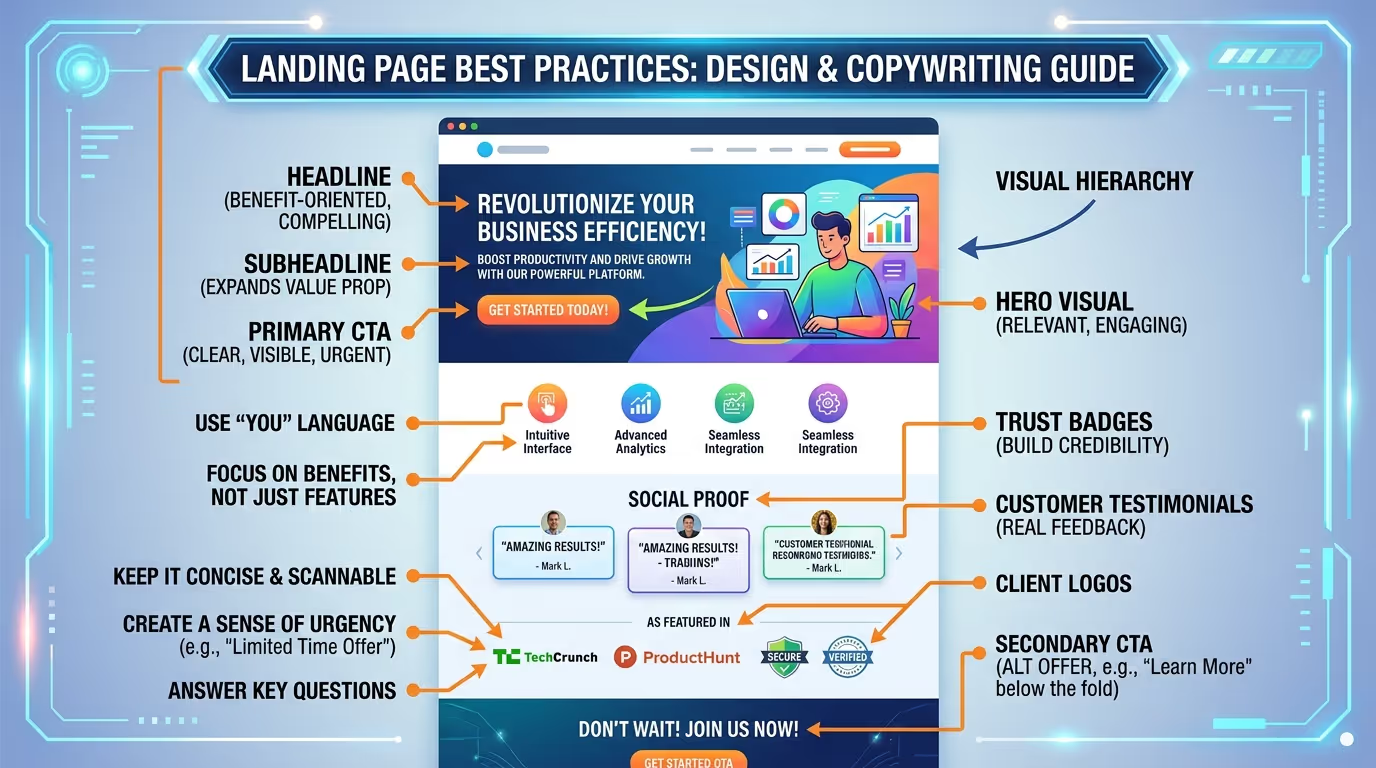
Most WordPress landing pages violate multiple landing page best practices in the speed, mobile, and SEO categories simultaneously — and the combined impact on conversion rates and rankings is significant.
Our Website Speed Optimization, SEO & Growth Optimization, and Custom WordPress Website Development services are built to identify and fix every performance, mobile, and SEO issue affecting your landing page conversion rates and search visibility.
Contact TecHippo today and let’s optimize your landing pages for maximum performance and conversions.
Landing Page Best Practices — Forms and Lead Capture
For lead generation landing pages, the form is the conversion mechanism — and how it is designed directly determines how many visitors complete it. These landing page best practices for forms maximize lead capture rates.
Keep Forms Short and Simple
Form length is one of the most directly tested variables in conversion rate optimization — and the consistent finding is that shorter forms produce more completions. Keeping forms short is one of the most universally applicable landing page best practices.
- Ask only for information you genuinely need to follow up effectively — resist the temptation to collect data points you might find useful later
- Name and email is sufficient for most consultation and lead magnet forms — every additional field reduces completion rates
- If your follow-up process requires a phone number, test whether making it optional rather than required improves completion rates
- Remove any fields that duplicate information you can gather during the follow-up conversation — the form’s job is to initiate contact not to complete a full client intake
- Consider using a multi-step form for longer data collection requirements — breaking a long form into two or three short steps consistently outperforms a single long form
Use a Clear and Compelling Form Headline
The headline directly above your form is a critical conversion element that is frequently overlooked in landing page best practices discussions — but it plays a significant role in the decision to complete the form.
- Use a benefit-focused headline that reinforces what the visitor gets by completing the form — “Get Your Free WordPress Website Quote” is more compelling than “Contact Us”
- Remind visitors of the specific next step — “Book Your Free 30-Minute Consultation” sets clear expectations about what happens after form submission
- Keep the form headline short — one line is ideal — and ensure it is visually prominent above the form fields
- Match the form headline to the CTA button text used elsewhere on the page for message consistency
- Use the first person in form headlines where appropriate — “Get My Free Quote” consistently outperforms “Get Your Free Quote” in A/B testing across multiple industries
Add Trust Signals Near Your Form
The moment a visitor is about to submit a form is the highest-anxiety point in the conversion journey — and trust signals placed adjacent to the form directly address the concerns that cause last-minute abandonment.
- Add a privacy statement below the form — “We never share your information. No spam, ever.” directly addresses the most common reason visitors hesitate before submitting
- Display your response time commitment near the form — “We respond within 24 hours” sets expectations and reduces post-submission anxiety
- Include a star rating or short testimonial adjacent to the form — social proof at the point of conversion is one of the most impactful landing page best practices for improving form completion rates
- Add recognizable trust badges — Google reviews badge, industry certifications, or security indicators — near the form submit button
- For TecHippo service pages, displaying the “100+ trusted clients” and “25+ professional team” stats adjacent to the consultation form reinforces credibility at the exact moment of conversion decision
Landing Page Best Practices — Testing and Optimization
The most effective landing page best practices are not assumed — they are proven through systematic testing against real visitor behavior data. These practices ensure your landing pages improve continuously rather than remaining static.
Run A/B Tests on Key Elements
A/B testing involves creating two versions of a landing page with one variable changed and measuring which version converts better. It is the most rigorous of all landing page best practices for continuous conversion improvement.
- Test one element at a time to ensure conversion changes can be attributed to the specific variable being tested
- Start with the highest-impact elements — headlines and CTA buttons typically produce the largest conversion differences
- Run tests long enough to collect statistically significant data — at minimum 100 conversions per variation before drawing conclusions
- Document all test results — including losing variations — to build a knowledge base that guides future optimization decisions
- Apply winning variations permanently before beginning the next test — never run multiple simultaneous tests on the same page as the results become uninterpretable
- Use A/B testing tools compatible with WordPress such as Google Optimize alternatives or built-in split testing features in your page builder
Use Heatmaps to Understand Visitor Behavior
Heatmaps reveal how visitors actually interact with your landing page — where they click, how far they scroll, and where their attention is focused. This behavioral data provides insights that A/B testing alone cannot deliver and is one of the most valuable landing page best practices for qualitative optimization.
- Use a heatmap tool to identify which elements on your landing page attract the most clicks and which are being ignored
- Check scroll depth data to understand how far visitors typically read — if most leave before reaching your CTA, it needs to be moved higher on the page
- Watch session recordings of real visitors interacting with your landing page to identify specific friction points or moments of confusion
- Use click maps to identify elements visitors are trying to click that are not actually clickable — a signal that those elements need to become interactive
- Look for rage clicks — repeated rapid clicks on the same element — as a signal that something is broken or not working as visitors expect
Track Conversions with Google Analytics
Without conversion tracking, you have no data foundation for any of the other testing and optimization landing page best practices — making proper analytics setup a prerequisite for all other optimization work.
- Set up conversion goals in Google Analytics 4 for every key action on your landing pages — form submissions, phone clicks, button clicks, and purchase completions
- Monitor conversion rate by traffic source to understand which channels are sending the most qualified visitors to your landing pages
- Track bounce rate and average session duration on landing pages to identify pages where visitors are leaving without engaging
- Set up funnel visualization to identify exactly where in the conversion process visitors are dropping off
- Compare landing page performance before and after optimization changes to measure the impact of specific improvements accurately
- Connect Google Analytics and Google Search Console to build a unified view of both traffic quality and ranking performance for each landing page
Our SEO & Growth Optimization service includes full conversion tracking setup and ongoing performance monitoring as part of every engagement.
Landing Page Best Practices for WordPress
WordPress provides an excellent platform for implementing landing page best practices — with the right tools and configuration, WordPress landing pages can achieve outstanding conversion performance.
- Use a dedicated page builder like Elementor or Beaver Builder that gives you full control over layout, design, and mobile responsiveness without requiring custom code — essential for implementing design-focused landing page best practices efficiently
- Choose a lightweight SEO-friendly theme as your foundation — Astra, GeneratePress, or Kadence provide the fast loading base that landing page best practices for speed require
- Disable unnecessary plugin scripts on landing pages using a performance plugin like Asset CleanUp — loading only the scripts genuinely needed on each page
- Use your SEO plugin to implement all on-page SEO best practices — meta title, meta description, canonical tag, and schema markup — on every landing page
- Create dedicated thank you pages for form submissions so conversions can be tracked accurately in Google Analytics and visitors receive a clear next step after completing the form
- Test every landing page on real mobile devices before launching any campaign — mobile experience issues discovered after launch are far more costly than those caught during development
- Set up heatmap tracking using a plugin like Microsoft Clarity before driving traffic to a new landing page — having behavioral data from the first visitor provides the foundation for faster optimization
Our Custom WordPress Website Development service builds conversion-optimized WordPress landing pages that implement every category of landing page best practices as standard — from clean fast design and benefit-focused copy to proper SEO setup and analytics configuration.
Common Landing Page Mistakes to Avoid
Even website owners who are aware of landing page best practices frequently make avoidable mistakes that undermine their landing page conversion performance.
- Multiple competing CTAs that confuse visitors about which action to take — every landing page needs one primary conversion goal
- Feature-focused copy that lists specifications without translating them into visitor benefits — visitors buy outcomes not features
- Keeping navigation menus on campaign-specific landing pages — every navigation link is an exit opportunity
- Generic stock photography instead of authentic images of real products, team members, or client results
- Slow loading pages caused by unoptimized images, too many plugins, or poor hosting — particularly damaging for paid advertising landing pages where every click costs money
- No mobile testing before launch — discovering broken mobile experiences after a campaign is live is costly and avoidable
- Vague CTA button text like “Submit” or “Click Here” instead of action-oriented benefit-driven alternatives
- Asking for too much information in forms with excessive required fields that increase abandonment before completion
- No social proof on the page — first-time visitors need evidence from other customers before they will trust a brand they do not know
- Never testing anything — assuming the first version of a landing page is the best it can be without any A/B testing or behavioral analysis
- Not tracking conversions — making all optimization decisions based on guesswork rather than data
Avoiding these mistakes is as important as implementing landing page best practices proactively — many landing pages fail not because they are missing specific features but because they are actively violating fundamental conversion principles.
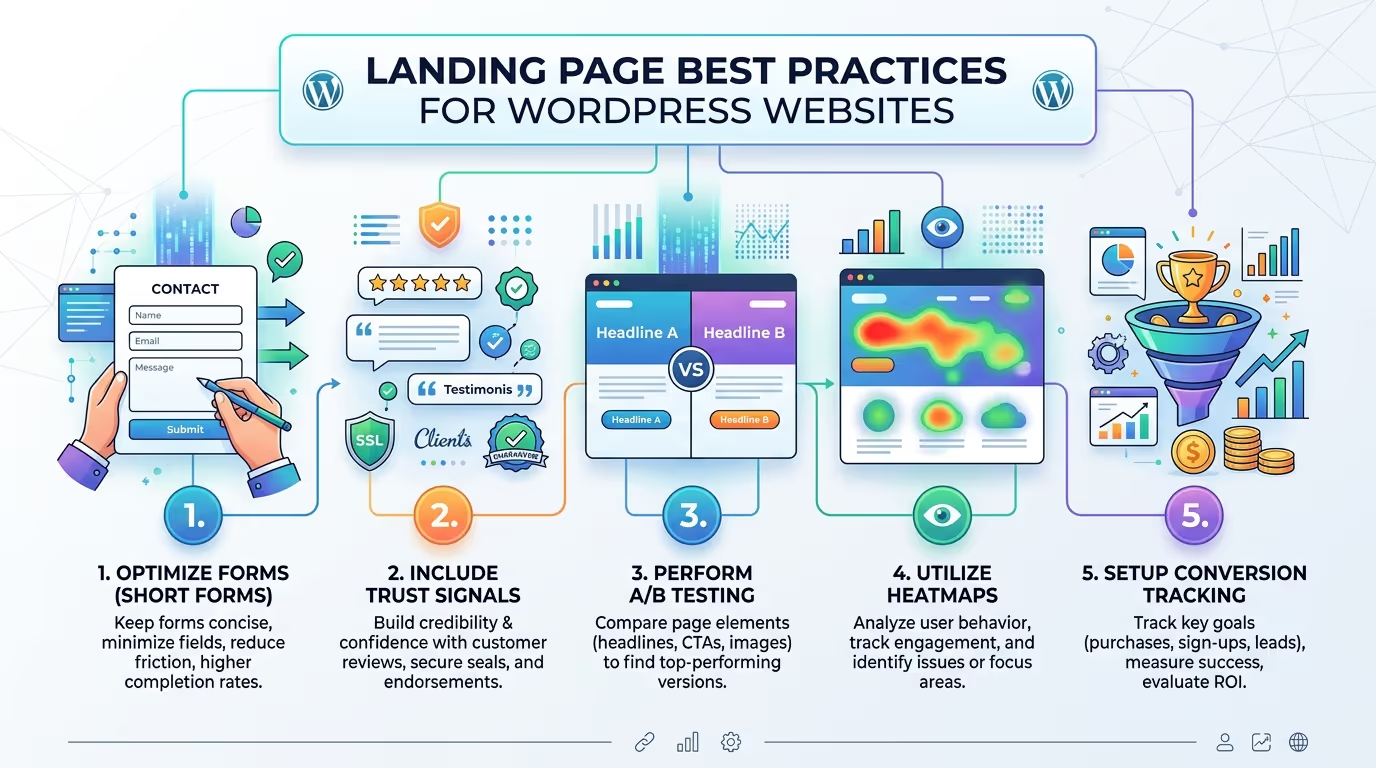
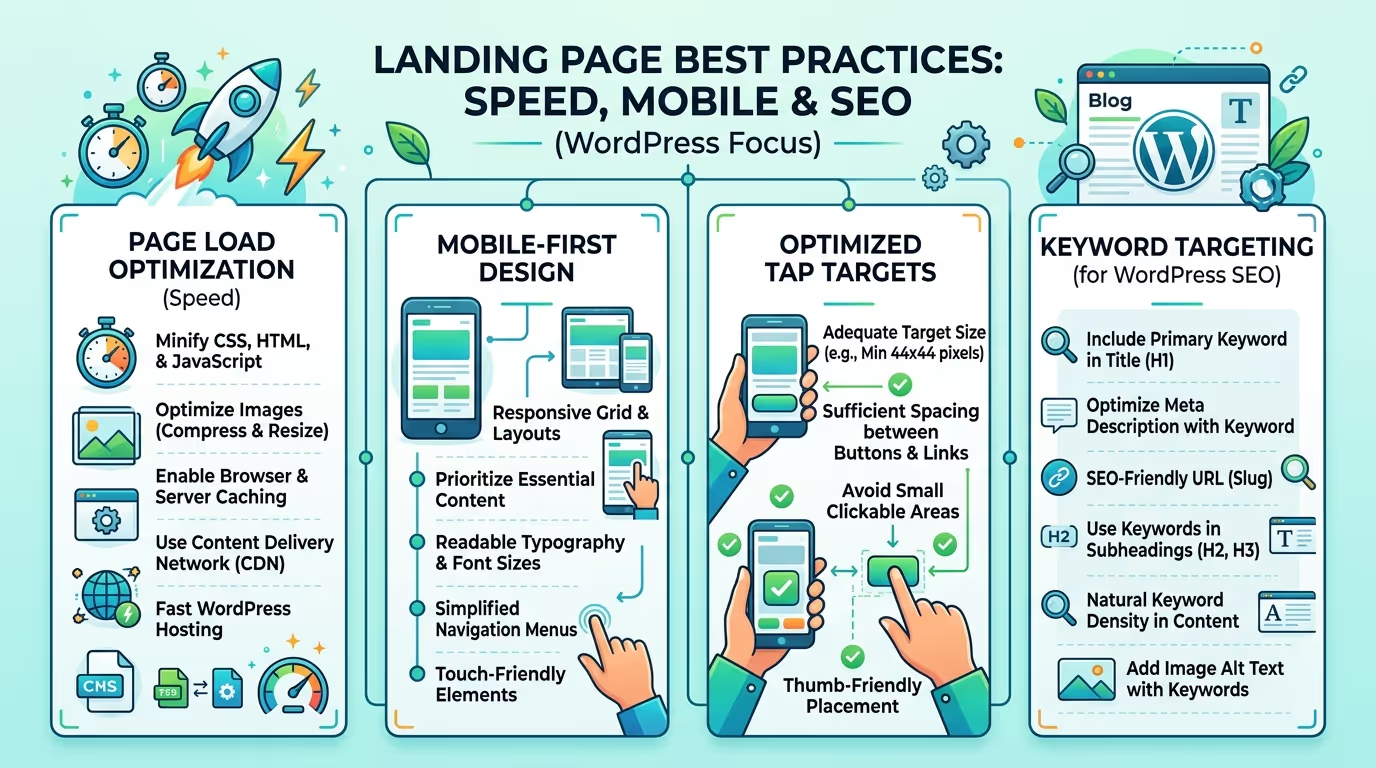
A landing page that follows every category of landing page best practices — from clean design and persuasive copy to fast loading speed, mobile optimization, proper SEO, and conversion tracking — is one of the most powerful business growth tools available to any WordPress website owner.
At TecHippo our Custom WordPress Website Development, SEO & Growth Optimization, Website Speed Optimization, and Monthly Website Management Plans are built to deliver landing pages that apply every proven landing page best practices principle — strategically designed, technically optimized, and continuously monitored to convert more of your visitors into customers.
Book a free consultation with TecHippo today and let’s build landing pages that turn your WordPress website into your most powerful customer acquisition tool.
Conclusion
Landing page best practices are not a checklist to complete once — they are a continuous framework for building, testing, and improving pages that convert visitors into customers more effectively over time.
By applying best practices across every dimension — clean focused design, benefit-driven copy, fast loading speed, mobile-first optimization, proper SEO, simplified forms, and systematic testing — you give every visitor who lands on your pages the best possible reason and opportunity to take action.
The businesses that treat landing page best practices as an ongoing discipline rather than a one-time setup are the ones that consistently convert more traffic, generate more leads, and grow their revenue more efficiently from every marketing channel they invest in.

 Reach us on WhatsApp