Affiliate disclosure: some links may earn TecHippo a commission at no extra cost to you. Check current prices and terms with the provider.
Last updated: 13 November 2026. Prices were checked on each seller’s own website.
An SSL certificate turns your site address from http to https and shows the padlock. It protects the data your visitors send, like passwords and card details. Most WordPress sites do not need to pay for one, because good hosts include a free certificate. But some sites do. This guide shows when to use free SSL, when to buy, and where to buy at a fair price.
Do you need to buy an SSL certificate?
For most blogs, business sites and online stores, no. Free certificates from Let’s Encrypt are trusted by all major browsers, and many hosts install them for you in one click. Check your host first. Our comparison of the best WordPress hosts shows which ones are worth using.
You may want to buy when:
- You need a wildcard certificate for many subdomains, and your host does not offer one.
- You need one certificate for several domains (a SAN or multi-domain certificate).
- You want a company-validated (OV) certificate, because a client or a payment partner asks for it.
- You want a warranty and support from a certificate seller.
- Your host charges for SSL or does not offer it.
DV, OV and EV: what is the difference?
| Type | What is checked | Best for | Typical cost |
|---|---|---|---|
| DV (Domain Validation) | You control the domain | Blogs, small sites, most WordPress stores | Free to about $10 a year |
| OV (Organization Validation) | Domain and company details | Business sites that want extra trust | About $20 to $60 a year |
| EV (Extended Validation) | Domain and a full company check | Banks and large brands | About $40 and up a year |
Important change: certificates now last 200 days
Since 15 March 2026, browsers only accept public SSL certificates that are valid for 200 days or less. The limit will keep getting shorter until 2029. When a seller shows a “5-year” plan, it means they reissue your certificate again and again during those years. See the DNSimple notice on the new validity rules.
Where to buy an SSL certificate
These prices were shown on the sellers’ websites on 13 November 2026. They change often, so check the cart total before you pay.
| Certificate | SSLs.com | Namecheap |
|---|---|---|
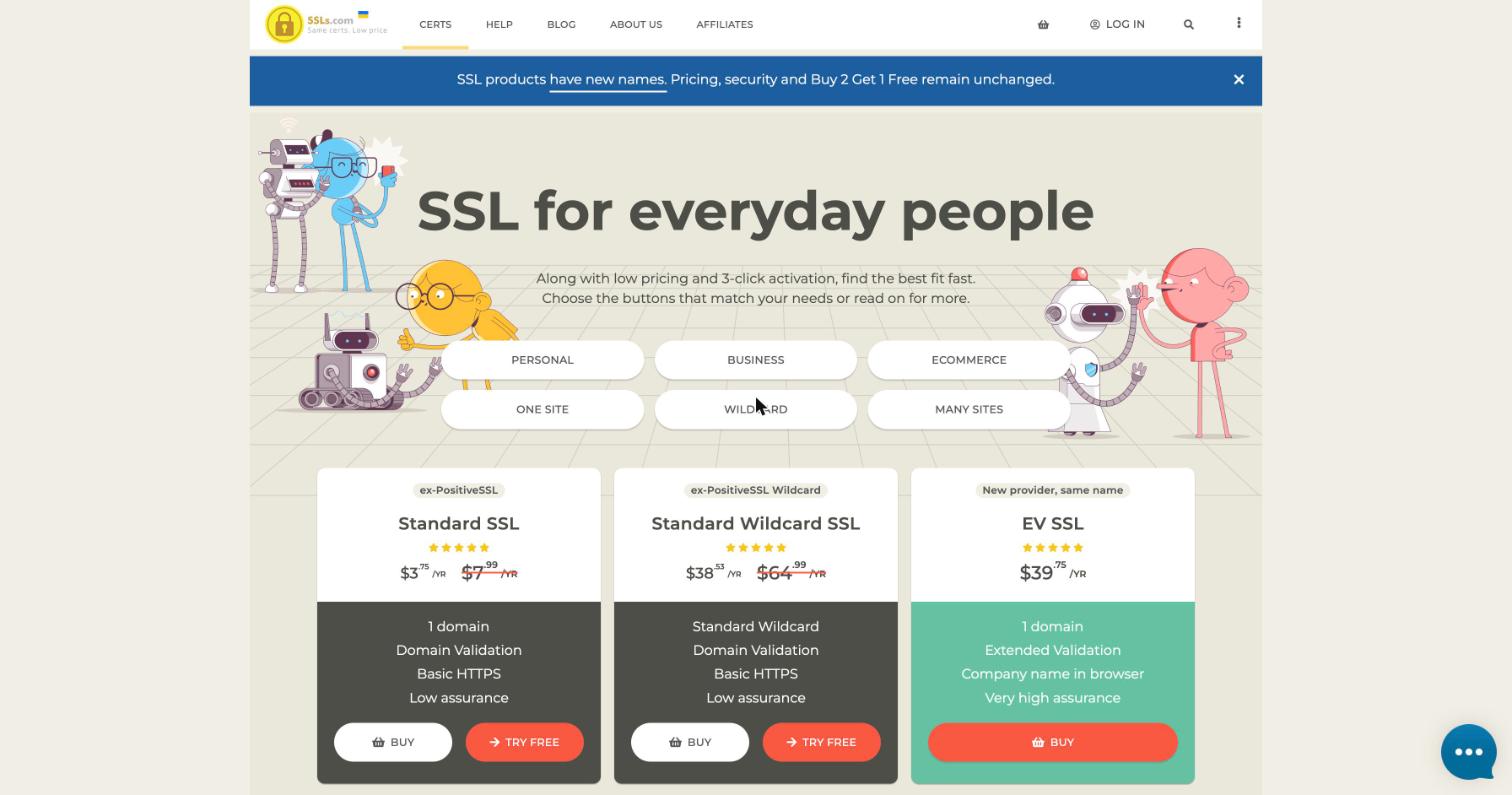
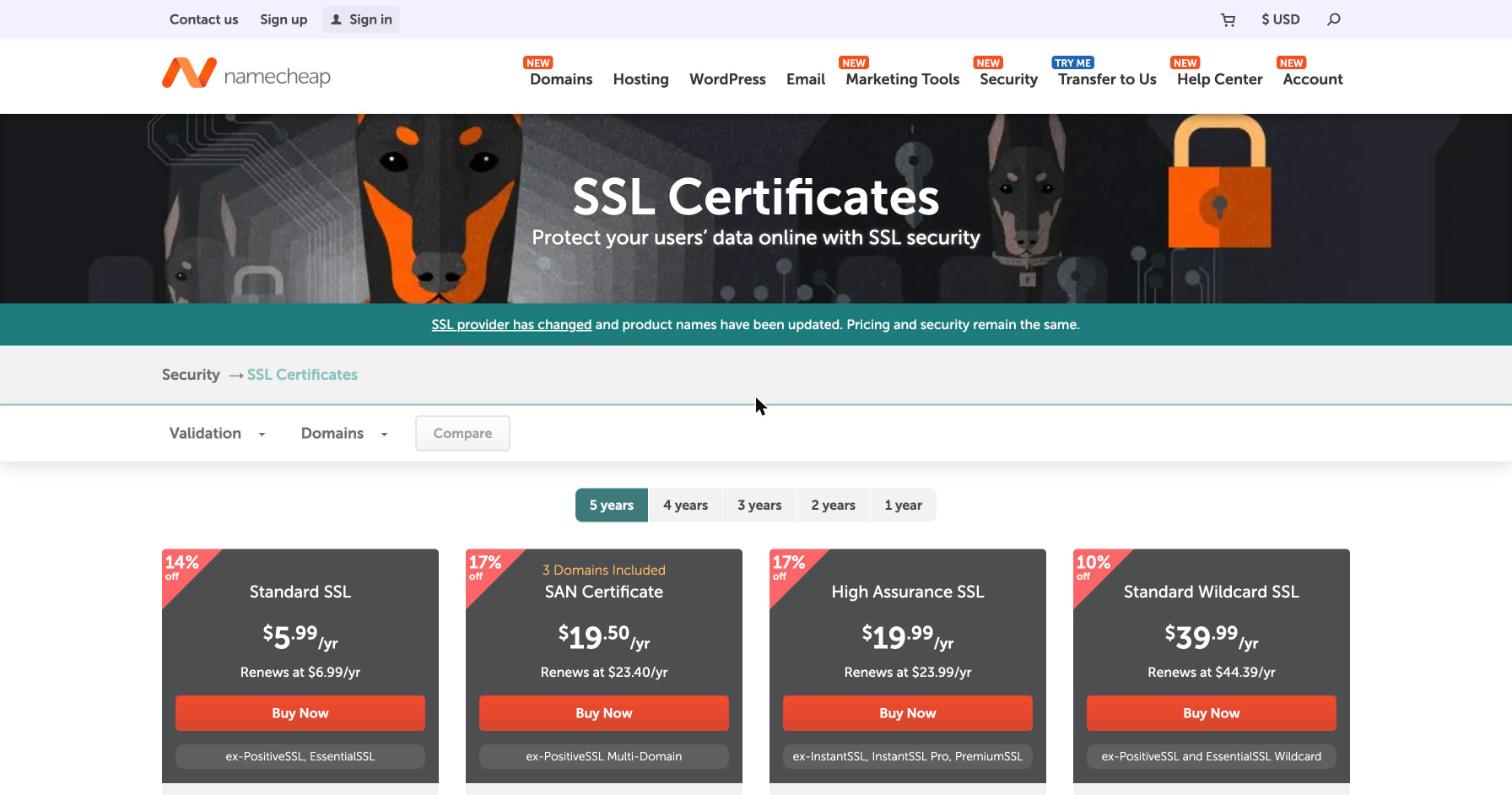
| Standard SSL (1 domain, DV) | $3.75/year | $5.99/year, renews at $6.99 |
| Wildcard SSL (DV) | $38.53/year | $39.99/year, renews at $44.39 |
| Multi-domain (SAN, 3 domains included) | See SSLs.com pricing page | $19.50/year, renews at $23.40 |
| High assurance or EV | EV from $39.75/year | High Assurance from $19.99/year, renews at $23.99 |
Namecheap shows its prices on 5-year plans. SSLs.com shows per-year prices and offers a free trial on some certificates.
1. SSLs.com: lowest price for paid certificates
SSLs.com focuses on low prices and simple setup. A standard certificate was $3.75 a year (listed at $7.99 before the discount). Wildcard was $38.53 a year and EV was $39.75. The site also runs a “Buy 2 Get 1 Free” offer and says it uses 3-click activation.
What we like
- undefinedVery low price for a standard certificate
- undefinedFree trial option on some certificates
- undefinedSimple activation steps
What to watch out for
- undefinedProduct names have changed after a provider switch, so match them carefully
- undefinedDiscount prices are tied to longer terms
2. Namecheap: easy if you already use Namecheap
Namecheap sells standard, multi-domain, high assurance and wildcard certificates. Standard SSL was $5.99 a year on the 5-year plan, renewing at $6.99. It is a handy choice when your domain is already there. If you do not own a domain yet, read our guide to the best domain registrar.
What we like
- undefinedClear price list with renewal prices
- undefinedBuy domain, hosting and SSL in one account
- undefinedSeveral certificate types
What to watch out for
- undefinedLowest prices need a long plan
- undefinedRenewal prices are higher than the first term
How to install SSL on WordPress
- Check your host first. Open your hosting panel and look for SSL, AutoSSL or Let’s Encrypt. Most hosts turn it on with one click.
- If you bought a certificate, follow the seller’s steps to activate it. You will create a CSR in your hosting panel, paste it into the seller’s page and confirm domain ownership.
- Install the certificate in your hosting panel. Many hosts have an “Install SSL” screen where you paste the certificate files.
- Back up your site. A full backup protects you if a setting breaks the site.
- Change the site URLs in WordPress Settings, General from http to https.
- Redirect all http pages to https and fix mixed content, which means images or scripts still loading from http.
- Test the site. Open it on your phone and your computer, and check that the padlock shows on every page.
Common SSL problems and fixes
| Problem | Likely cause | Fix |
|---|---|---|
| “Not secure” warning | Site still loads on http or has mixed content | Switch URLs to https and fix mixed content |
| “Your connection is not private” | Certificate expired or wrong domain | Renew or reissue the certificate for the exact domain |
| Too many redirects | Redirect rules conflict between plugin and server | Keep only one https redirect rule |
| Padlock missing on some pages | Images or scripts load from http | Replace http links with https |
If this feels like a lot, our team can handle it. See our WordPress website care plan for ongoing security checks.
Frequently asked questions
Do I need to buy an SSL certificate for WordPress?
Usually no. Most good hosts include a free SSL certificate. Buy one only if you need a wildcard, a multi-domain or a company-validated certificate, or a warranty.
Is free SSL as secure as paid SSL?
Yes for encryption. Free and paid domain-validated certificates use the same strong encryption. Paid certificates add company checks, warranty and support.
How much does an SSL certificate cost?
On 13 November 2026, a standard certificate started at $3.75 a year at SSLs.com and $5.99 a year on Namecheap. Wildcard certificates were about $38 to $40 a year.
How long does an SSL certificate last?
Public certificates are now limited to 200 days since 15 March 2026. Sellers reissue them automatically on longer plans, so turn on auto-renew.
Does SSL help SEO?
Google uses HTTPS as a small ranking signal. More importantly, visitors trust a padlock and leave less when they see one.
What is a wildcard SSL certificate?
It covers your main domain and all its subdomains, like blog.example.com and shop.example.com, with one certificate.
What is the difference between DV, OV and EV?
They differ in how much the seller checks. DV checks only the domain. OV also checks the company. EV does the deepest check. All give the same encryption.
Sources and how we checked
- Seller pricing pages, checked 13 November 2026: SSLs.com and Namecheap SSL certificates.
- Certificate validity rules: DNSimple: SSL certificate validity changes 2026 to 2029.
- Prices change often. Confirm the total in your cart before you pay. Some links on this page are affiliate links. We may earn a commission at no extra cost to you.